The Honest Answer
There is no objectively correct answer — it depends on your circumstances, your goals, and what matters most to you. This article breaks down the real differences so you can make the right choice.
What's the Difference?
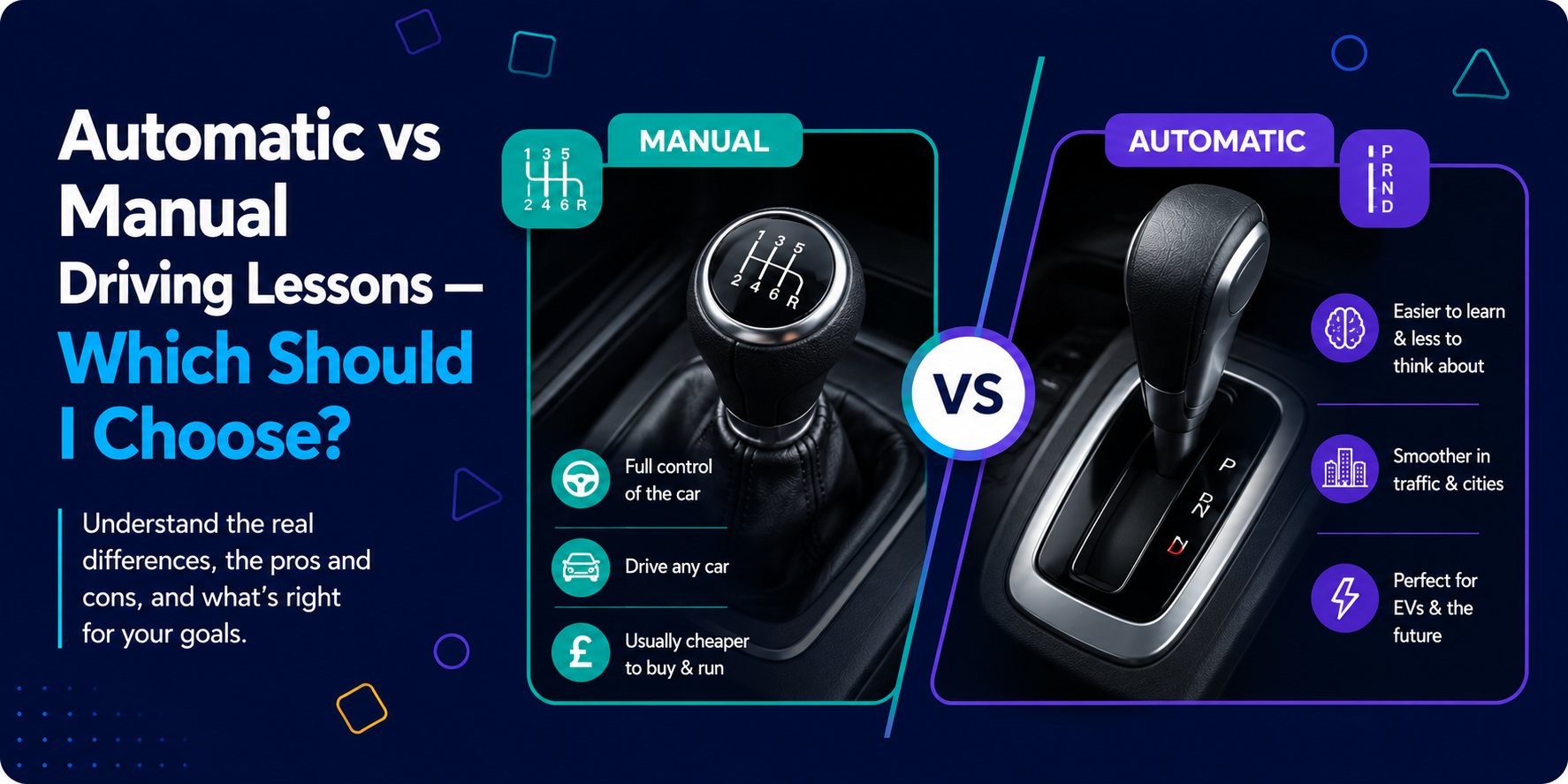
In a manual car, you control the clutch and gearbox yourself. You choose when to change gear, engage the clutch to do so, and manage the car's power delivery through junctions, hill starts, and stop-start traffic.
In an automatic car, the gearbox does all of that for you. You have two pedals (accelerator and brake), no clutch, and the car selects gears automatically.
The Licence Restriction
This is the most important practical difference:
If you pass your test in a manual car, your licence covers you to drive both manual and automatic vehicles.
If you pass your test in an automatic car, your licence is restricted to automatic vehicles only. You cannot legally drive a manual without taking and passing another practical test.
Arguments for Learning in a Manual
More flexibility long-term
A manual licence gives you the option to drive any car. Around 80% of cars for sale in the UK are still manual — though this is changing rapidly.
Usually cheaper to buy and run
Manual cars are generally less expensive to purchase and slightly cheaper to maintain. This matters if you're planning to buy your first car on a tight budget.
Potentially more engaged driving
Some drivers feel more connected to the road and more in control in a manual.
Arguments for Learning in an Automatic
Easier to learn
Removing the clutch and gear changes from the equation dramatically reduces the cognitive load for new drivers. Instead of managing three pedals, gear selection, clutch biting point, and road awareness simultaneously, you only deal with two pedals.
Faster to reach test standard
Most learners in automatics need fewer lessons to reach test standard. This means lower total lesson costs.
Better for people with certain physical conditions
Learners with conditions affecting hand, wrist, or leg mobility often find automatics significantly easier.
Urban driving is much smoother
If you're learning to drive in a city, stop-start traffic in a manual is genuinely exhausting. Automatics handle it effortlessly.
The EV Factor
Nearly all electric vehicles are automatic. As the UK moves toward its 2035 target of ending new petrol and diesel car sales, choosing automatic now arguably future-proofs your licence.
Who Should Learn in a Manual?
Consider a manual if:
You already drive off-road or have some clutch control experience
You want maximum flexibility and are happy with a slightly longer learning journey
You plan to buy a manual car after passing
You're not in a rush and cost-per-lesson is less of a concern than total licence flexibility
Who Should Learn in an Automatic?
Consider an automatic if:
You're a complete beginner with no prior driving experience
You have any physical conditions affecting leg or hand mobility
You want to pass as quickly and cost-efficiently as possible
You live and drive primarily in a city
You're planning to drive an EV
Anxiety is a factor — fewer things to manage means less to be anxious about
Can You Switch Partway Through?
Yes, though it means starting gearwork from scratch if switching from automatic to manual. If you're several lessons into a manual and finding the clutch genuinely overwhelming, there is no shame in switching to automatic. Talk honestly with your instructor.
Find an Instructor Who Teaches Both
Many instructors teach only one type. Browse instructors offering both automatic and manual lessons in Manchester, Birmingham, London, and more on Driveli.