Overview: What Is the DVSA Practical Driving Test?
The DVSA practical driving test is the final step before you receive your full UK driving licence. It lasts around 40 minutes and takes place on public roads near your chosen test centre, with a DVSA examiner in the passenger seat.
The test costs £62 on a weekday and £75 on evenings and weekends. In 2022/23, the overall pass rate was approximately 49% — so slightly under half of all candidates pass on their first attempt.
Before the Test: What to Bring
Your valid UK provisional photocard driving licence
Your theory test pass certificate (if issued before 2014; modern certificates are linked electronically)
The booking confirmation email or reference number
Arrive 10–15 minutes before your appointment. Your instructor will normally drive you to the test centre and wait during your test.
The 'Show Me, Tell Me' Safety Questions
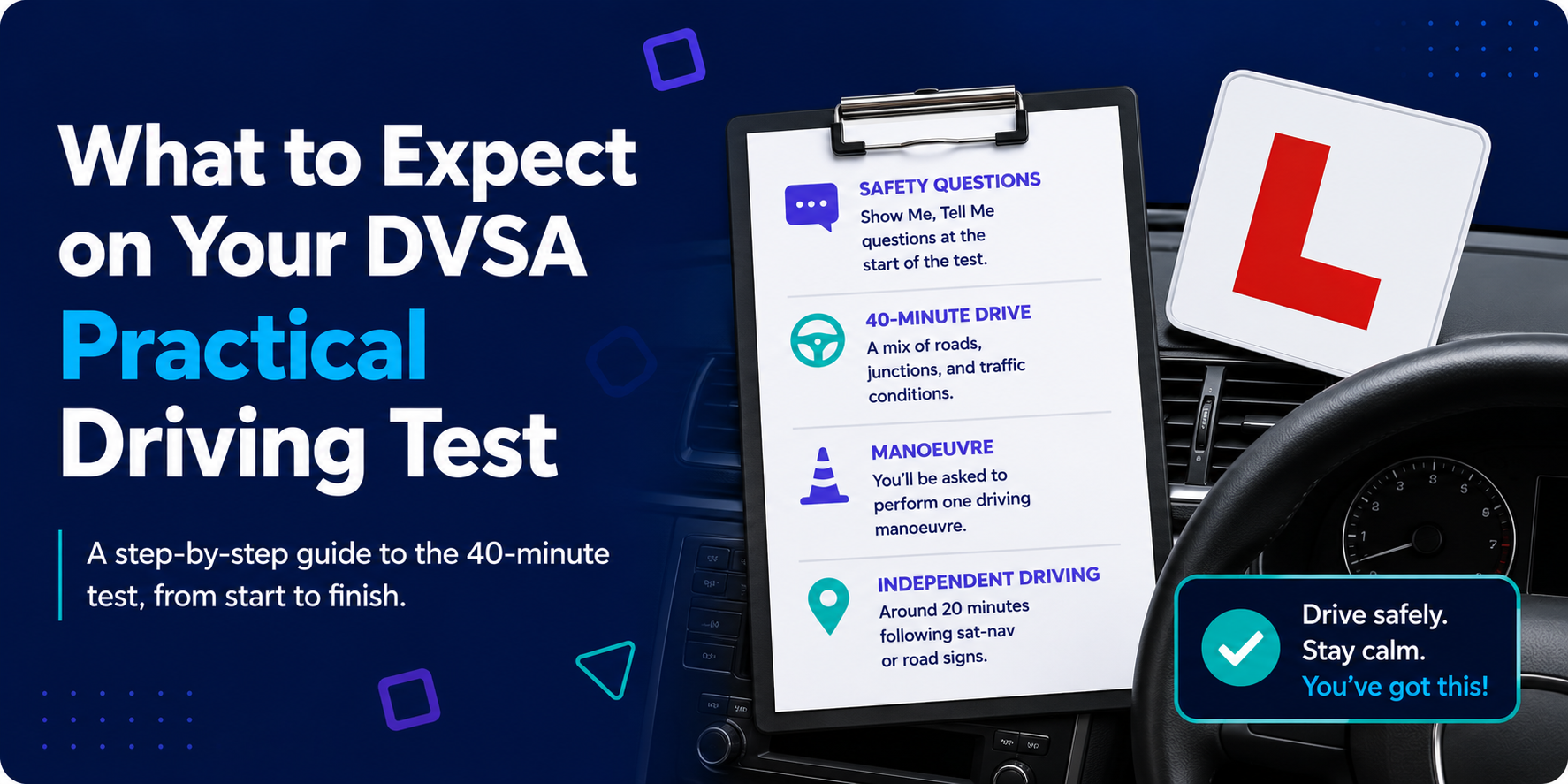
The test begins before you even start the engine. The examiner will ask one 'tell me' question outside the car and one 'show me' question during the drive. These cover basic vehicle safety checks.
Tell me questions (asked outside the car)
"Tell me how you would check the brakes are working before starting a journey."
"Tell me where you would find the information for the recommended tyre pressure for this car."
"Tell me how you would check that the headlights and tail lights are working."
Show me questions (asked while driving)
"When it's safe to do so, show me how you would wash and clean the rear windscreen."
"Show me how you would use the rear demister."
"Show me how you would open and close the side window."
The 40-Minute Drive
The route will cover a variety of road types and traffic conditions, including:
Residential streets
Town centre roads
Dual carriageways or faster A-roads where available near the test centre
Various junction types — T-junctions, crossroads, roundabouts
Independent Driving (20 Minutes)
For approximately 20 minutes of the test, you'll be asked to drive independently, either following sat-nav directions or road signs to a destination.
If you take a wrong turn during the independent driving section, this is not an automatic fault — what matters is how safely you respond, not whether you follow the perfect route.
The Manoeuvre
You'll be asked to perform one manoeuvre during the test. There are four possible manoeuvres:
Parallel park behind another vehicle
Park in a bay — either driving in and reversing out, or reversing in and driving out
Pull up on the right side of the road, reverse two car lengths, rejoin traffic
Forward bay park in a car park
You'll also be asked to perform an emergency stop during roughly one in three tests.
How Faults Are Scored
Driving faults (minors) — Small errors that don't put anyone in immediate danger. You can accumulate up to 15 driving faults and still pass.
Serious or dangerous faults (majors) — Any single serious or dangerous fault results in an immediate fail.
Common serious fault categories include: not checking mirrors before manoeuvring, pulling out at junctions without adequate observation, crossing solid white lines, and failing to respond appropriately to traffic signals.
Tips for Test Day
Sleep properly the night before — Fatigue affects reaction times and decision-making.
Have a lesson on test day morning — A warm-up drive before the test gets your mind into driving mode.
Trust your training — If your instructor has booked you in, they believe you're ready.
Drive as if your instructor is in the car — Examiners aren't looking for perfect driving. They're looking for safe driving.
Don't speed up when nervous — Keep your eyes on speed limit signs.
Ready to Start Preparing?
Find a highly-rated instructor in your area on Driveli — search by city to see test centre pass rate data, compare instructors, and book your first lesson.
Find instructors in Birmingham, Manchester, London, and across the UK.